If you are moving to Dubai, or already here and rethinking your child’s school, you have probably felt the same two worries: which of the many international schools in Dubai actually fits your family, and whether the fees are sustainable year after year. Dubai has more than 220 private schools offering British, IB, American, and Indian (CBSE) curricula, so choice is not the problem. Clarity is. This honest guide walks you through seven real international schools in Dubai, with curriculum, age range, indicative annual fees, and location for each. We also cover fee ranges, how to choose the school that suits your household, and an eighth option for families for whom commuting or cost has become a wall. Use it as a calm map for finding the one school that fits your child.
Quick Answer: Your Options in Dubai
If you only read one section, read this. Below are the schools covered in this guide, plus the online option — so you can see every route side by side before the details.
- Dubai College — Age range: 11–18 (Years 7–13)
- GEMS Wellington International School — Age range: 3–18
- Dubai International Academy Emirates Hills — Age range: 4–18
- GEMS Dubai American Academy — Age range: 4–18 (KG–Grade 12)
- GEMS Modern Academy — Age range: 4–18
- The Indian High School Dubai — Age range: 3–18
- Repton School Dubai — Age range: 3–18
- NIJIN GLOBAL ACADEMY (online) — Ages 6–18 / opening September 2027, currently taking opening-update registrations / fees around one-fifth of a typical campus international school / Japanese-language support. An option when commute or fees are the wall.
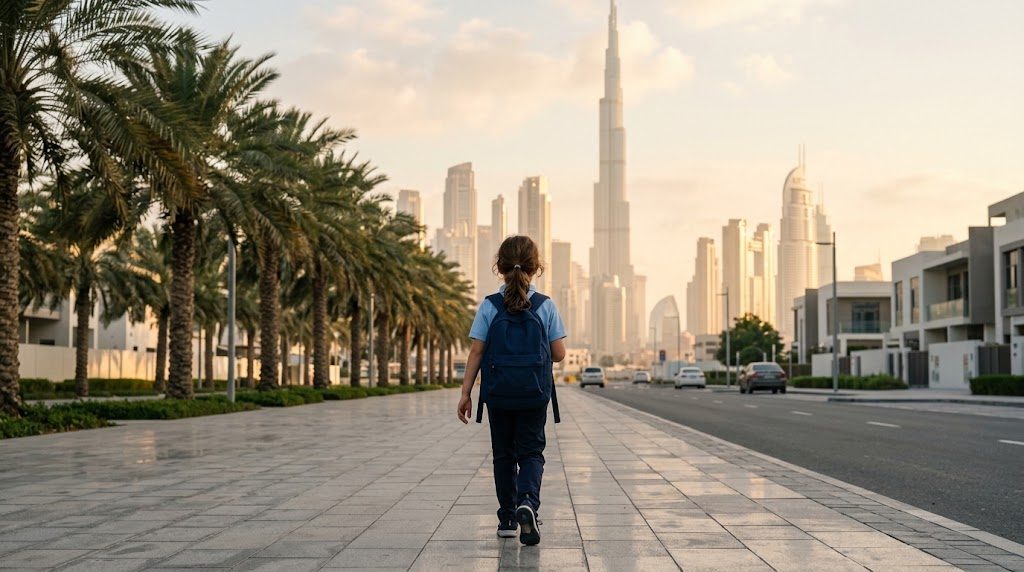
International schools in Dubai: the landscape and fee ranges
Every private school in Dubai is inspected each year by the KHDA (Knowledge and Human Development Authority) and rated on a five-point scale: Outstanding, Very Good, Good, Acceptable, and Weak. There are around 220 private schools, 17 curricula, and more than 365,000 pupils enrolled. British is the most common curriculum, followed by Indian (CBSE), IB, and American. It is, quite literally, a world of education in one city.
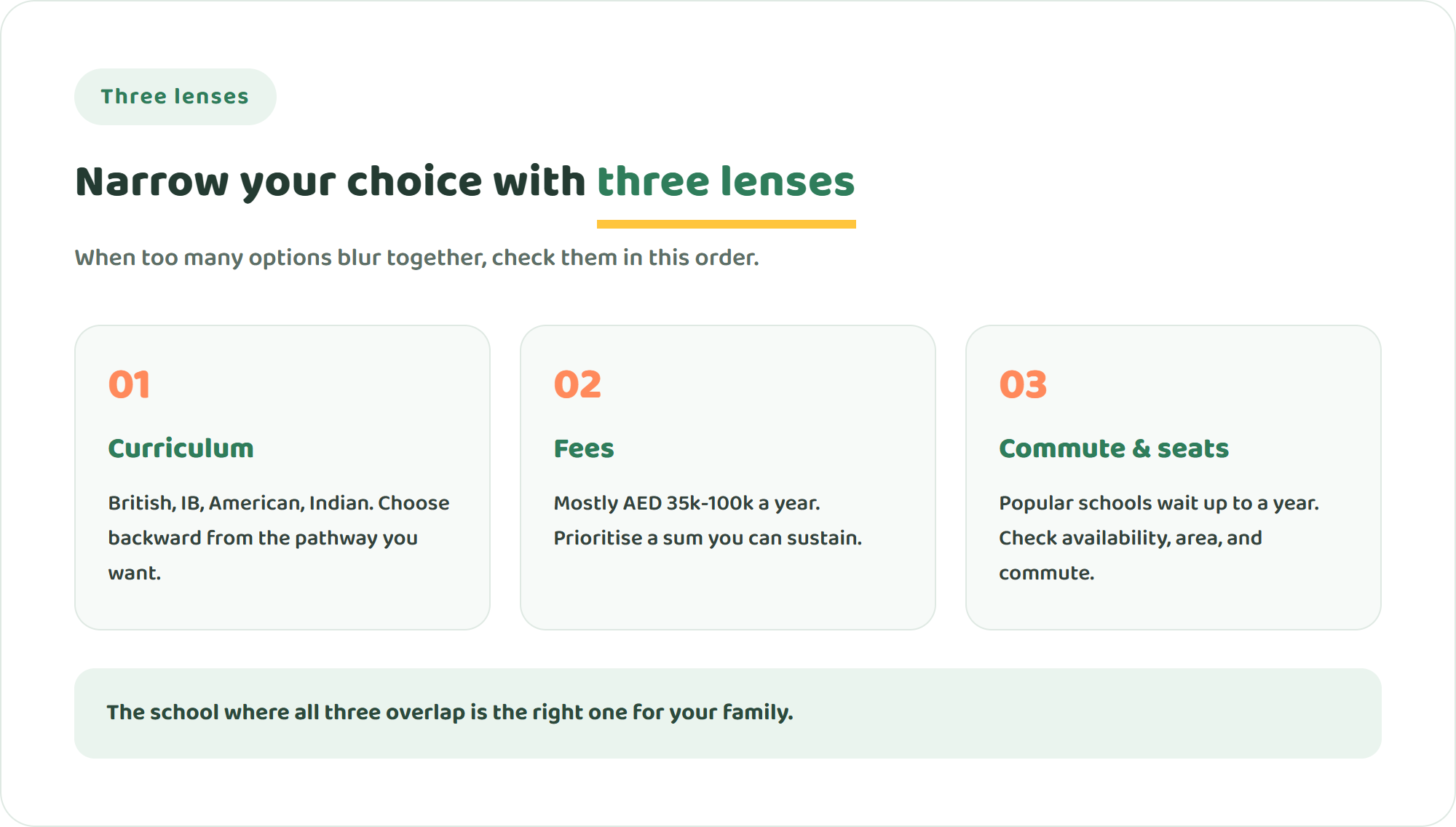
Fees vary widely by curriculum and grade. Indian curriculum (CBSE/ICSE) schools are the most affordable at roughly AED 7,000–22,000 a year. Mid-tier British and American schools run AED 35,000–55,000, established names AED 55,000–80,000, and premium IB Diploma years can reach AED 80,000–120,000. In short, most international schools in Dubai sit in the AED 35,000–100,000 band per year (roughly USD 9,500–27,000). Treat every figure here as indicative; grade and academic year both change the number.
Demand has become intense. As families relocate from around the world, applications have risen by as much as 40%, popular schools carry waiting lists across every year group, and waits of up to a year are not unusual. Supply has not kept pace, and Dubai has plans for around 100 new schools by 2033. “We found a school we love, but there was no seat” is a real scenario here.
7 best international schools in Dubai
The seven schools below were chosen for a balance of curriculum and price, drawing on KHDA ratings and published information. Fees are indicative ranges that shift by grade and year. Start by narrowing your shortlist to two or three schools that genuinely interest you.
1. Dubai College
One of the UAE’s leading British schools. Its A-Level results rival top UK independent schools and its university placement record is exceptional. It focuses on Years 7–13 (secondary), with academics at the heart of its long tradition.
- Curriculum: British (GCSE, IGCSE, A-Level)
- Age range: 11–18 (Years 7–13)
- Indicative fees: around AED 100,000 per year
- Area: Al Sufouh
- Best for: families prioritising academics and top UK/global university entry
2. GEMS Wellington International School
A British school rated KHDA Outstanding for ten consecutive inspections. Alongside GCSEs it offers the IB Diploma, with a strong balance of academics, sport, and the arts, from KG all the way to Year 13.
- Curriculum: British with IB Diploma option
- Age range: 3–18
- Indicative fees: about AED 47,500–103,400 per year
- Area: Al Sufouh
- Best for: families who want to keep both British and IB pathways open
3. Dubai International Academy Emirates Hills
The only full-IB school in Dubai (PYP, MYP, DP, CP) to hold a KHDA Outstanding rating. Its inquiry-based approach builds globally minded learners, on a calm campus in Emirates Hills.
- Curriculum: full IB continuum (PYP, MYP, DP, CP)
- Age range: 4–18
- Indicative fees: about AED 45,000–80,000 per year
- Area: Emirates Hills
- Best for: families wanting a continuous, inquiry-led IB education
4. GEMS Dubai American Academy
Rated Outstanding since 2011, it is Dubai’s only Outstanding American-curriculum school. The US programme can be combined with Advanced Placement and the IB Diploma.
- Curriculum: American with AP and IB Diploma options
- Age range: 4–18 (KG–Grade 12)
- Indicative fees: about AED 66,200–93,300 per year
- Area: Al Barsha
- Best for: families focused on US university entry or an American approach
5. GEMS Modern Academy
The only Indian-curriculum (CISCE) school rated Outstanding by the KHDA. IB MYP and DP are also available, making it popular with families who want high standards at a lower fee.
- Curriculum: Indian CISCE with IB (MYP, DP)
- Age range: 4–18
- Indicative fees: about AED 10,000–49,000 per year
- Area: Nad Al Sheba
- Best for: families wanting strong Indian/IB education at a moderate cost
6. The Indian High School Dubai
One of Dubai’s oldest and largest Indian (CBSE) schools. Annual fees are very affordable, making it a natural choice for families who put cost first. KHDA rating: Very Good.
- Curriculum: Indian (CBSE)
- Age range: 3–18
- Indicative fees: about AED 5,500–10,500 per year
- Area: Oud Metha and other campuses
- Best for: families keeping fees as low as possible with a proven Indian school
7. Repton School Dubai
Inspired by the historic Repton in England, this British-plus-IB school sits on a large campus and holds a KHDA Outstanding rating. It is known for whole-child education rooted in its house tradition.
- Curriculum: British with IB
- Age range: 3–18
- Indicative fees: about AED 60,000–90,000 per year
- Area: Nad Al Sheba (Dubai–Sharjah side)
- Best for: families who value a traditional British ethos and spacious facilities
Note: fees and details reflect publicly available information as of July 2026. Please confirm the latest figures on each school’s official website. Fees can be revised, and availability and admission conditions (such as assessments) should always be checked directly with the school.
Comparing your options: how to choose the school that fits
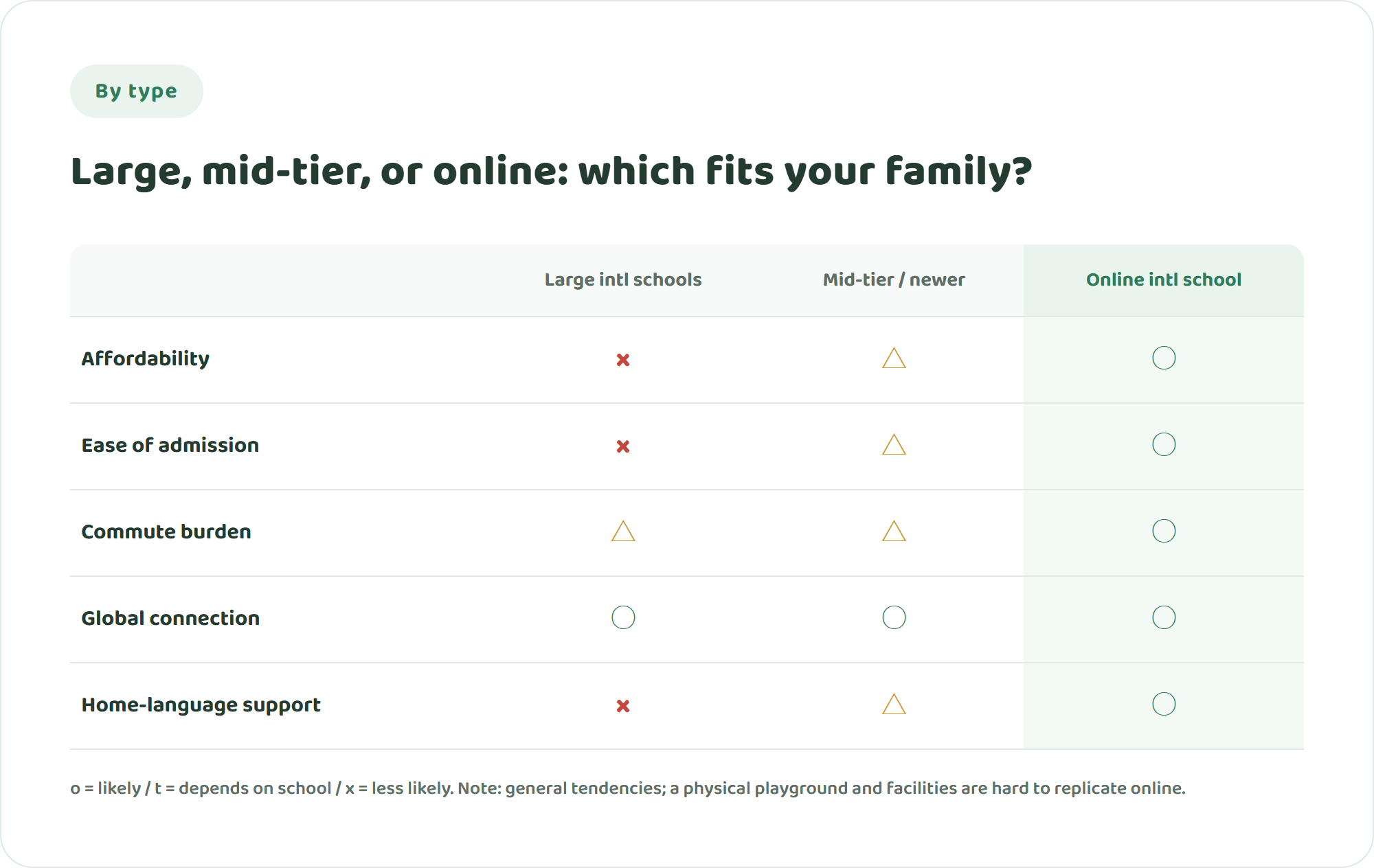
Lined up side by side, the seven schools reveal your decision axes: curriculum (where the pathway leads), fees (a sum you can sustain), and commute plus availability (whether you can actually attend). In Dubai, “is there a seat?” is as real a barrier as the fee itself. The table below honestly compares large international schools, mid-tier/newer schools, and online international schools on the points families care about.
If cost is your main concern, our breakdown of grade-by-grade fees and hidden costs in this guide to international school tuition is worth a read. Notably, a growing number of families are moving from Singapore (roughly USD 20,000–33,000 a year) to Dubai (roughly USD 7,000–20,000) for cost reasons; if fees feel out of reach, comparing with international schools in Singapore can help you rethink the city itself. Curious about the learning model? See how learning works online →

When fees or the commute are the wall: online as an eighth option
Having read through these seven schools, you may feel that fees exceed your budget, that popular schools are full, or that you would rather not keep changing schools every time you move. For those families, we want to offer an eighth option: NIJIN GLOBAL ACADEMY (NGA).
NGA is an online international school scheduled to open in September 2027. It is run by NIJIN Inc. of Japan, which operates NIJIN Academy, an alternative school with more than 1,000 enrolled learners. NGA moves away from ranking children by test scores, centres on small-group dialogue, and holds to a simple aim: to help children “come to love themselves and the world.” It aims to keep fees at around one-fifth of a face-to-face international school, serves ages 6–18 across Asia and Oceania, works wherever you live, and is designed so children can ease into English with Japanese-language support as a foundation. It is meant especially for families caught on Dubai’s waiting lists or moving frequently.
In honesty, NGA has not opened yet, so its track record is still to come, and it is not exactly the same as the campus, playground, and facilities of a face-to-face school. Even so, being able to continue a global education at a lower cost, free from where you live or whether a seat is open, can be a real source of peace of mind.
Frequently asked questions
Q. From what age can children join international schools in Dubai?
Most schools admit from KG (age 3–4). At sought-after schools the younger year groups fill first, so applying early is wise. NGA is for ages 6–18.
Q. Is Japanese-language support available?
Local international schools in Dubai are essentially English-medium, and Japanese support is usually arranged separately by each family. If English is a worry, using an online school designed around Japanese-language support alongside can be an option.
Q. Can my child transfer mid-year?
Some schools accept transfers whenever a place opens, but popular schools have long waits and typically require an assessment (academic and English). Timing depends on availability, so contacting several schools early gives you the most peace of mind.
Not the perfect school, but a place where your child can grow with confidence
There is no single right answer in choosing a school. What matters is not rankings or reputation, but whether your child can feel safe and come to like who they are. Dubai has many wonderful schools. And if none of them quite fit your family, a form of learning unbound by place or cost is also a path. Take your time, and choose at your and your child’s own pace.
International Schools in Other Cities
- International Schools in Tsukuba: Fees
- International Schools in Sendai: 7 Picks and Fees
- International Schools in Shinjuku: Fees
- International Schools in Karuizawa: All 4 Schools
- International Schools in Sapporo: Fees
- International Schools in Meguro: All 8 Schools
- International Schools in Manila
- International Schools in Melbourne
- International Schools in Minato: Fees
- International Schools in Tokyo
- International Schools in Osaka
- International Schools in Singapore
- International Schools in Bangkok
- International Schools in Sydney
- International Schools in Kuala Lumpur