“I can barely speak English myself — how could I possibly raise a bilingual child?” If that thought has ever made you hesitate, you are far from alone. You open an English picture book and stumble over the words. You try to say something simple and freeze. And quietly, a little voice says: maybe this just isn’t for our family.
So let’s start with the honest answer: yes, you can raise a bilingual child even if you don’t speak English yourself. In fact, your own fluency matters far less than one other thing. In this article, we’ll be honest about what actually drives a child’s language growth, and lay out what you can start doing at home — from the perspective of educators who do this every day.
The relief first: bilingualism is not decided by the parent’s English
Here is where so many families get stuck. The belief that “unless I’m fluent, my child won’t pick up English” simply isn’t true. All over the world, children grow up fluently bilingual in homes where the parents speak not a word of the second language.
What a language actually needs in order to grow is not a parent’s perfect accent. It’s meaningful, repeated exposure — and a real reason to use the words. Children don’t learn pronunciation from their parents alone. They learn it from songs, videos, books, and above all from real people to talk to. So your job isn’t to become the teacher. It’s to set up the environment and help your child keep going.
Three things that matter far more than your English
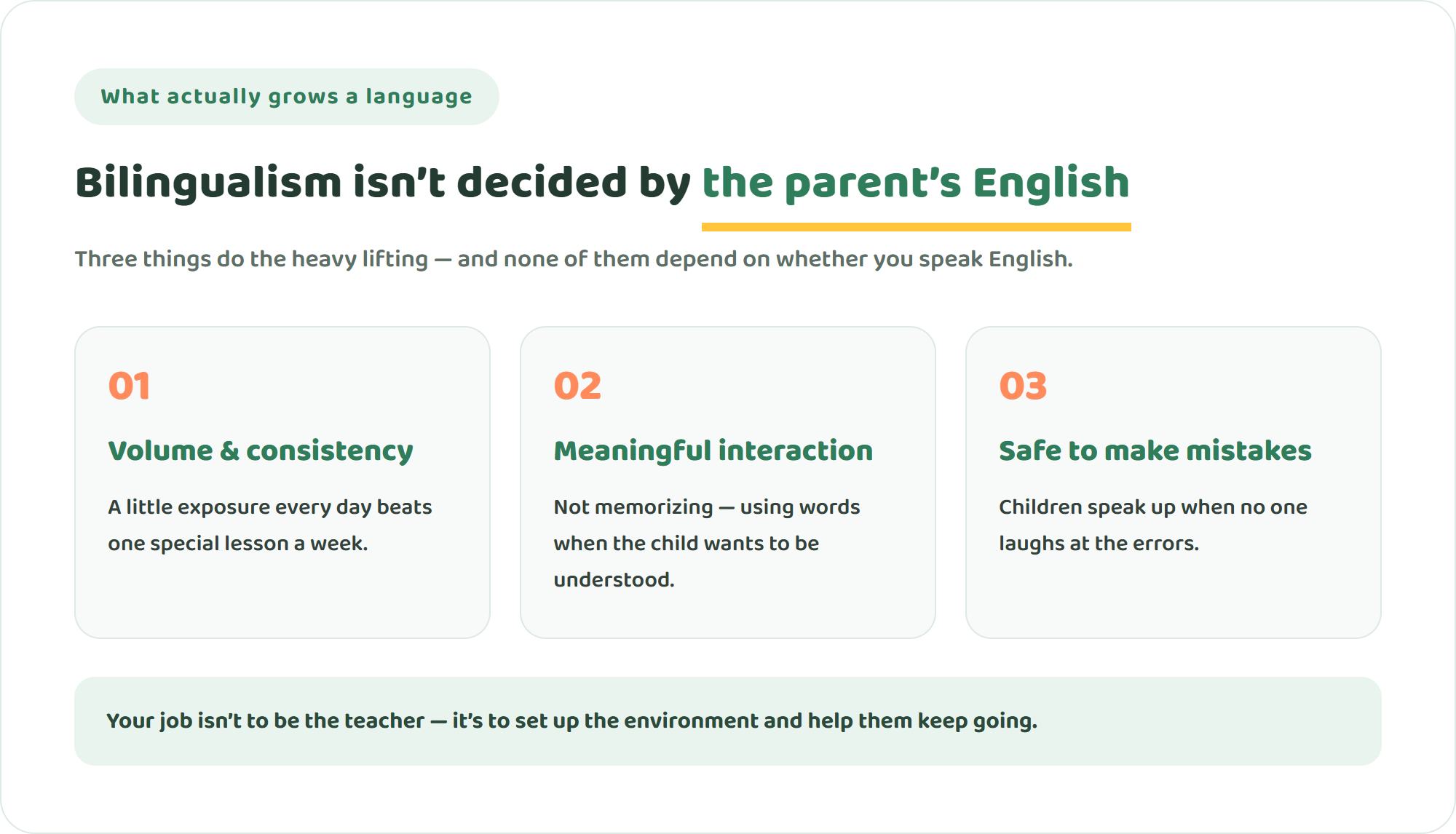
So what really shapes whether a child becomes bilingual? In our experience, these three things do the heavy lifting:
- Volume and consistency — a little exposure every day beats one special lesson a week, by a wide margin.
- Meaningful interaction — not memorizing words, but using them in moments where the child genuinely wants to be understood.
- Safety to make mistakes — children open their mouths when no one laughs at the errors.
Notice something: none of these depend on your English. If anything, a parent who isn’t confident in English has an advantage — you get to sit beside your child and say, “I don’t know this one either, let’s figure it out together.” That attitude is the best model a child can have.
What you can start doing at home today
You don’t need expensive programs or study abroad. There’s a lot you can do at home — and the goal is never “perfect,” it’s “a little, every day.”
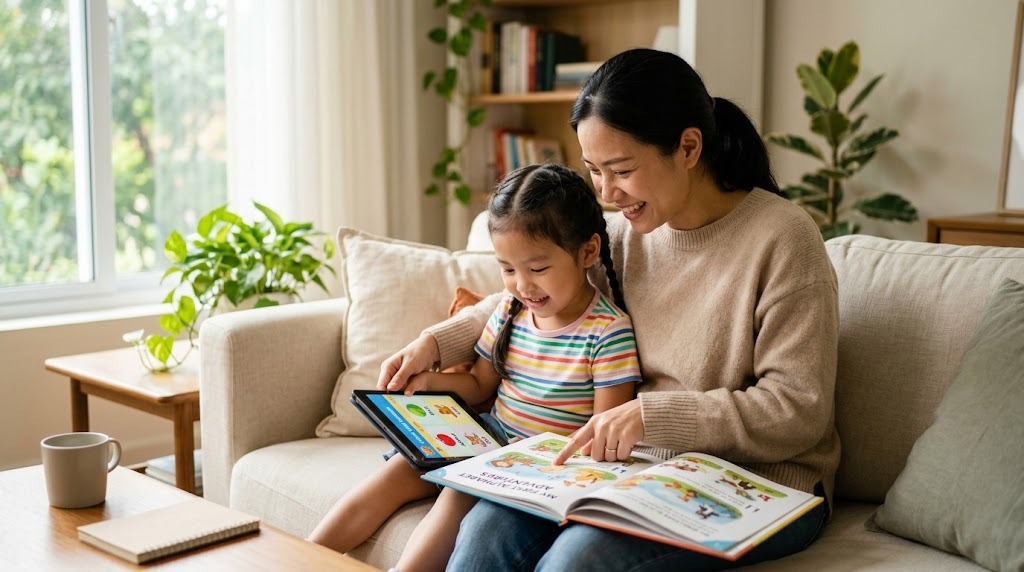
- Put English sounds into daily life — English songs during the morning routine, an English picture book at night. Even without understanding the meaning, the shower of sound builds a foundation.
- Don’t just leave videos running — watch together and ask, “What do you think they just said?” That one question turns passive watching into active learning.
- Learn alongside your child — “I don’t know either, let’s look it up together” is a quietly powerful sentence. It builds their confidence, not just their vocabulary.
- Give them a real person to talk to — this is the key. A recorded voice can’t react; a real conversation partner who responds to what your child says is what turns a language into a living skill.
The first three you can do on your own. But the fourth — a real conversation partner — is the one most families can’t create inside the home. And that’s exactly where the wall usually appears.
Where families get stuck: the limits of apps and classes
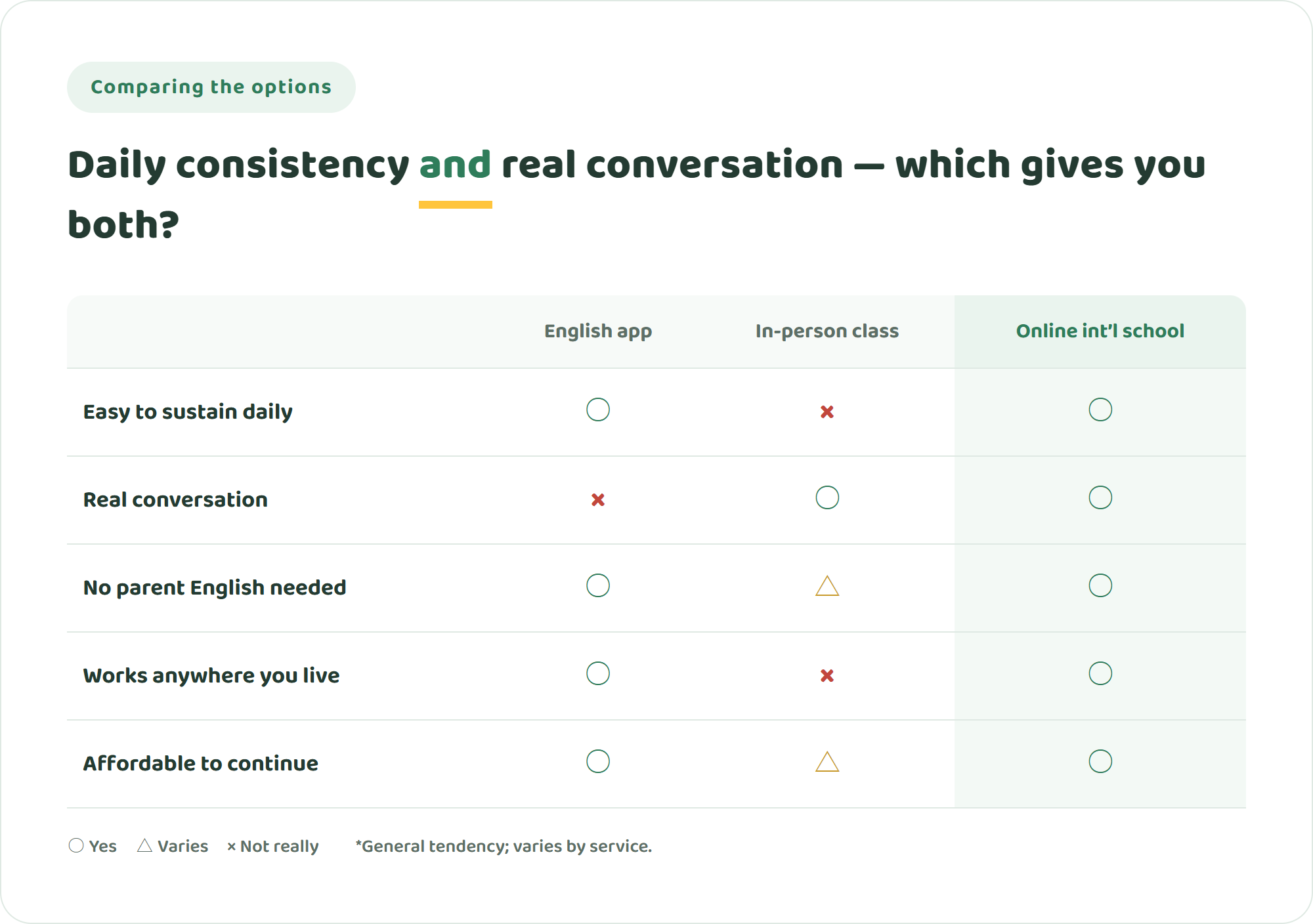
Language apps are convenient, but most are built for “one child, alone, facing a screen.” When your child says something, nothing on the other side lights up with recognition. Yet language grows precisely on the joy of being understood — and that’s what a screen can’t give back.
In-person English classes do offer real interaction, but once a week for an hour rarely supplies the volume and consistency a language needs. Add the driving, the cost, and the simple fact that some areas have no good school nearby, and “an environment you can actually sustain” becomes hard to reach.
A third option: learning with the world, every day, from home
So what if you could combine real conversation with daily consistency — without leaving home? That’s the idea behind an online international school.
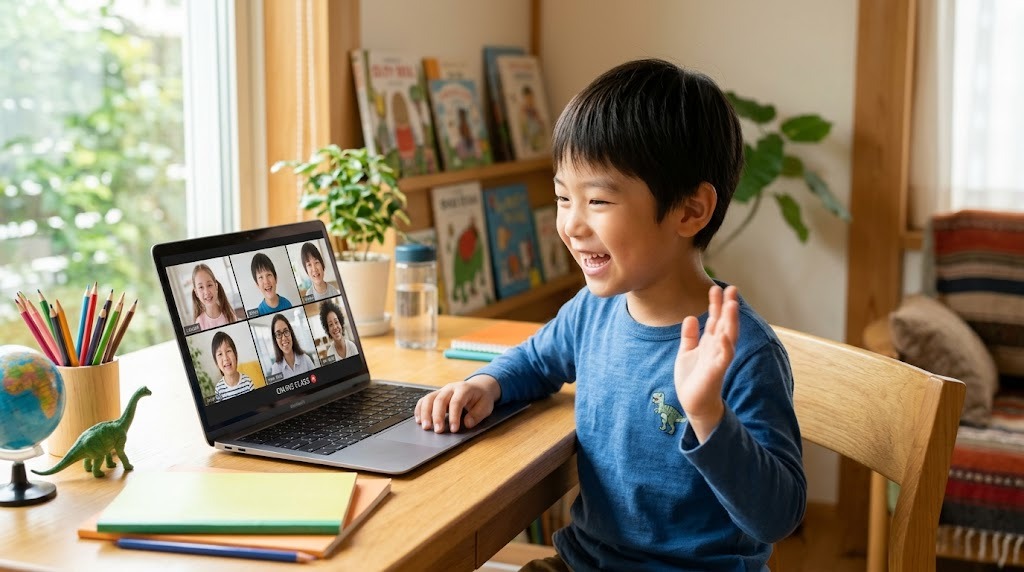
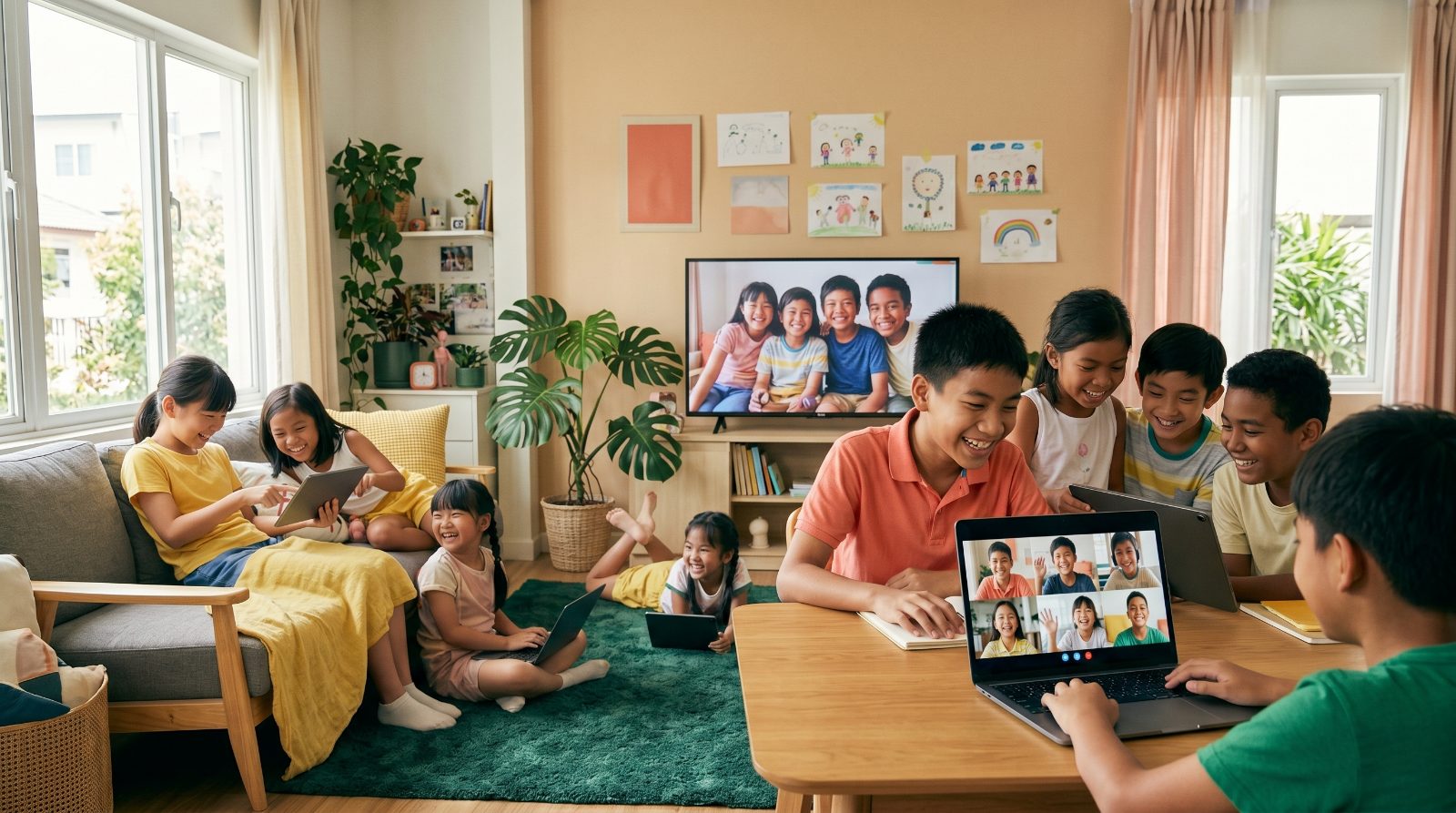
At NIJIN GLOBAL ACADEMY (NGA), English isn’t treated as a subject to be drilled. It’s the language children use to learn and talk with peers around the world. Every child is paired with a bilingual mentor, so a child who is brand new to English is supported in their first language and guided gently into the English-speaking world. That’s why it works even if you don’t speak English — your role stays simple: set the environment, and cheer them on.
“But can my child really do this?” That worry is natural. Yet our alternative school in Japan, NIJIN Academy, already serves more than 1000 children — many of whom struggled in conventional schools and slowly rebuilt their confidence at their own pace. We’re now bringing that same education to children across Asia and Oceania. And tuition is about one-fifth of a typical in-person international school — affordability that, in bilingual parenting, turns into the power to keep going.
See how learning works at NGA →
An honest note: it isn’t for everyone
To be straight with you: online is not identical to in-person. Your child won’t share the air of the same classroom or run around a schoolyard at recess. And if there’s no English at all in the home and you hand everything to the school, progress will be slower. A child’s language grows fastest when small daily habits at home and a place for real conversation work together — both wheels turning.
The point was never “the parent must speak perfect English.” It’s this: how will you give your child a reason — and a person — to want to use the language?
Frequently asked questions
Can it really work if I don’t speak any English at all?
Yes. Each child is paired with a bilingual mentor and supported in their first language. You aren’t asked to teach English — only to set up a sustainable environment and stay alongside your child.
Is there an age that’s “too late” to start?
Starting early helps a child get used to the sounds, but it’s never “too late.” What matters more than age is whether they can keep going a little each day. At any age, real conversation grows real language.
Can my child do this while attending a local school?
Yes. Many families plan to keep their local school and learn with NGA alongside it. Being able to continue regardless of where you live is one of the great strengths of learning online.
Let “I can’t do this” come to an end.
Whether your child becomes bilingual is not decided by how well you speak English. It’s decided by the environment you build — how you keep them in steady contact with the language. You don’t have to be a perfect parent. As long as someone is willing to sit beside them and say “let’s learn together,” a child will reach for new words with confidence.
NIJIN GLOBAL ACADEMY opens in September 2027. We’ll share how our bilingual education works, and news about our first cohort, by email first. A global education your child can actually reach.
Honest Answers to Your Worries — related reading
- Will My Child Lose Their Mother Tongue?
- The Honest Pros and Cons of International School
- Disadvantages of Bilingualism in Childhood: Myths vs Research
- Who Regrets International School — and Who Doesn’t
- International School Special Needs: What to Look For
- International School vs Local School: How to Decide
- Does International School Hurt Your Child’s Home Language?
- When Your Child Is Struggling at International School
- Do International Schools Make Children Fluent in English?
- Is International School Worth It? What Happens to Graduates
- Should I Send My Child to International School?
- Transfer From a Local School to an International School
- Disadvantages of Early English Education: What Research Says
- What Happens to International School Graduates
Get opening updates by email →
More on choosing an international education
- School Refusal? An Online International School Can Reopen Learning——A route back into learning
- How Do You Nurture the Skills Standardized Tests Cannot Measure?——Beyond exam scores
- The Best Age to Start Learning English for Kids——Too early? Too late?
- Online International Education in Asia and Oceania: 7 Options Compared——An honest comparison
- Where Do International School Graduates Go?——University outcomes, honestly
- Affordable International Education for Your Child——How to keep costs down
- Positive School Refusal: Supporting a Child Who Learns Outside School——Practical support for families
- International School Fees in Asia by Country——An honest comparison, and the online third path
- Are There Subsidies for International Schools?——Realistic ways to lower the cost
- A Cheaper Alternative to a Singapore International School——Affordable online options